

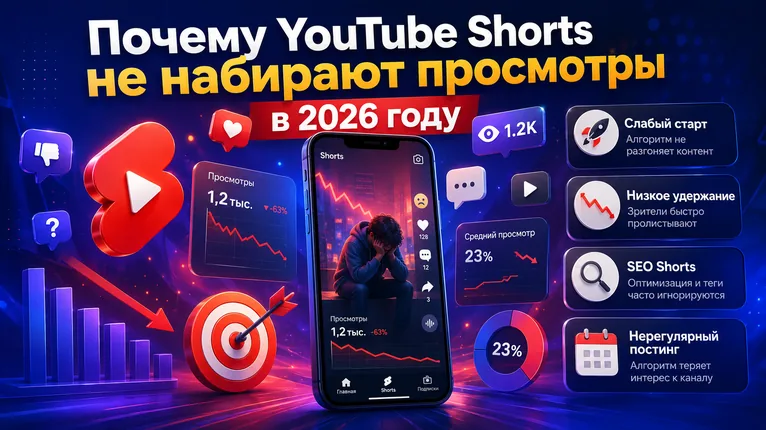
Why YouTube Shorts are not getting views in 2026
YouTube Shorts is still one of the fastest ways to get views, new subscribers and a first contact with an audience. But for many creators the picture looks odd: one clip gathers thousands of views, the next stalls at 30–100, and then the channel seems to start getting impressions again.
In 2026 the old Shorts playbook no longer works. It is not enough to upload a vertical video, add a popular sound and a few hashtags. YouTube now watches viewer behaviour far more closely: who stayed on the clip, who scrolled straight past, who rewatched, who opened the profile, who liked or subscribed.
When Shorts do not get views, the problem is almost never a single factor. Usually it is a combination of a weak opening, low retention, an unclear subject and poor delivery.
How the YouTube Shorts algorithms work in 2026
Shorts are promoted through the recommendation system. YouTube shows a clip to a small group of viewers and watches how they respond.
The algorithm assesses:
whether people stop on the video;
how many seconds they watch it;
whether they watch it through to the end;
whether they rewatch it;
whether they like it;
whether they leave comments;
whether they open the channel;
whether they subscribe after watching;
whether the clip matches a particular audience's interests.
If the first viewers scroll past a Short quickly, it may get very few further impressions. But if the audience watches to the end, rewatches and interacts, YouTube starts widening its reach.
It is worth understanding that Shorts do not always «die» forever after the first few hours. Some clips get a new wave of impressions a day, a week or even longer later, if YouTube finds the right audience for them.
1. A weak first couple of seconds
In Shorts the first 1–2 seconds decide almost everything. Users scroll the feed very fast, and a clip has almost no time to warm up.
A bad opening usually looks like this:
a long intro;
an empty first frame;
text that appears slowly;
no clue what the video is about;
the author takes ages to get to the point;
no intrigue or conflict.
In 2026 Shorts work better when the point is clear immediately. Within a second a person should think: «Oh, this is about me», «I wonder what happens next», «I need to watch this through».
Examples of a strong opening:
«Here's why your Shorts aren't getting views»
«Almost every beginner on YouTube makes this mistake»
«If your Shorts get 100 views — check this»
«YouTube isn't promoting your clip for a reason»
A good hook does not have to be clickbait. It has to explain the clip's value fast.
2. Low audience retention
The main enemy of Shorts is the early swipe. If people leave after 1–3 seconds, YouTube reads that as a sign the clip did not catch the audience.
Retention is affected by:
editing pace;
how the shots change;
clip length;
how clear the idea is;
audio quality;
whether there is on-screen text;
the energy of the delivery;
how the clip ends.
Shorts of 7–15 seconds often work better than long clips, because they are easier to watch through. But a short format alone does not guarantee views. If the clip is empty, dull or confusing, people will still scroll past.
A good Short carries the viewer from the opening to the finish with no sagging. It should contain no unnecessary pauses, no long title cards and no moments where the user has time to get bored.
3. The video gives no clear reason to watch to the end
Many Shorts share one problem: the clip is fine in itself, but the viewer cannot see why they should watch it to the end.
The algorithms like videos that create an expectation of a payoff:
before / after;
mistake / fix;
question / answer;
problem / conclusion;
intrigue / resolution;
a list of useful points;
a story with an unexpected ending.
If the viewer grasps everything in the first seconds, they may leave. If they understand nothing at all, they will leave too. You need a balance: the opening must catch attention, but the core value should unfold gradually.
For instance, instead of an ordinary «how to set up your profile» clip, make:
«3 profile mistakes that stop your Shorts getting views»
That format is clearer, more specific and holds attention better.
4. The wrong Shorts length
There is no single ideal length for every channel. But in 2026 plenty of creators get it wrong in both directions.
Videos that are too short may not have time to land the idea. Videos that are too long lose retention if they lack a strong structure.
For most niches these work well:
6–10 seconds — memes, reactions, visual gags;
10–20 seconds — tips, short how-tos, life hacks;
20–35 seconds — stories, breakdowns, mini-explainers;
35–60 seconds — only if the clip genuinely holds attention.
If a 45-second Short is watched for an average of 8 seconds, that is a bad signal. Better to make the clip shorter and denser and cut everything unnecessary.
5. The clip's subject does not match the channel's audience
YouTube tries to work out who to show your content to. If a channel keeps changing subject, it is harder for the algorithm to pick an audience.
Say a channel publishes:
comedy;
product reviews;
a personal blog;
news;
gaming;
motivation;
business advice.
The result is that YouTube cannot tell who the channel's core viewer is. One clip appeals to one audience, the next to a completely different one. That makes the recommendations unstable.
To grow with Shorts it is better to pick a clear niche and stick to it for a while. That does not mean filming the same thing over and over. But a channel should have a shared subject, style and an identifiable viewer.
6. The Shorts look like re-uploads
YouTube promotes content that looks unoriginal less readily. That goes doubly for mass re-uploads, videos with other platforms' watermarks and other people's content used without reworking.
Problems can come from:
a TikTok watermark;
other people's clips used unchanged;
identical templates;
repetitive cut-ups;
poor video quality;
suspiciously bulk publishing.
If you take an idea from another creator, rework it: change the delivery, the script, the visuals, the editing, the voiceover and the point. Simply downloading someone else's video and uploading it as a Short is a poor strategy.
7. Poor packaging
In Shorts, the thumbnail and title do not work the same way as on regular videos, but they still matter. A clip can appear not just in the Shorts feed but in YouTube search, in recommendations, in the channel's section and in external search results.
A bad title:
«My new clip»
«Watch to the end»
«So true»
«Part 2»
A good title:
«Why Shorts don't get views»
«How to reach the YouTube Shorts recommendations»
«3 beginner mistakes in Shorts»
«Why YouTube stopped showing your video»
A title should contain the key phrase and explain what problem the clip solves.
8. No SEO optimisation for YouTube
YouTube is not only a video platform but a search engine. In 2026 SEO for Shorts became far more important.
YouTube analyses:
the video title;
the description;
on-screen text;
the voiceover;
the subtitles;
the channel's subject area;
viewer behaviour after watching.
If a clip has an unclear name, an empty description and no keywords on screen, it is harder for YouTube to identify its subject.
For Shorts SEO it is worth adding natural key phrases:
how to get views on Shorts;
why Shorts don't take off;
how to reach the YouTube recommendations;
how to increase views on YouTube;
why a video isn't getting views.
There is no need to turn the description into a keyword dump. Two or three normal sentences that clearly explain the subject are enough.
9. Too many hashtags
Many people still add dozens of hashtags under their Shorts. In 2026 that no longer gives much of an advantage.
Hashtags help YouTube identify a clip's subject, but they do not rescue weak content. If a video does not hold the viewer, even perfect hashtags will not produce steady views.
The best approach:
2–5 relevant hashtags;
keywords on the subject;
no spam or filler tags;
no random popular hashtags.
For example:
#shorts
#youtube
#promotion
#shorts2026
#views
Fewer but more precise is better.
10. Inconsistent publishing
Shorts like consistency. If you publish 5 clips in one day, disappear for two weeks and then upload something random, growth will be erratic.
That does not mean you have to publish 10 videos a day. The system matters more.
For most channels this rhythm works:
1–3 Shorts a day;
testing different formats;
analysing retention;
repeating the topics that worked;
dropping weak templates.
If daily publishing is not possible, 3–5 strong clips a week beats uploading a lot of weak content.
11. The channel is too new
New channels often get erratic impressions. YouTube does not yet know exactly who to show the clips to, which audience responds best and which topics suit the channel.
So the first Shorts may get:
0–50 views;
100–500 views;
1000+ views;
then fall again.
That is normal. At the start a series of publications matters more than any single clip. You have to give the algorithm more data.
If the channel is new, do not draw conclusions after 2–3 videos. Better to upload at least 20–30 Shorts in one niche and see which topics start getting a response.
12. The video gets views but no subscribers
Sometimes Shorts get plenty of views but the channel barely grows. That means the clip may be entertaining without generating any interest in the author or the channel's subject.
That happens when:
the video has nothing to do with the overall niche;
there is no reason to subscribe;
the clip is a one-off;
the viewer cannot tell what the channel is about;
the profile does not continue the theme.
To make Shorts bring subscribers, build content in series. For example:
«Shorts promotion mistakes»
«Channel teardowns»
«What's stopping you getting views»
«YouTube algorithms in plain language»
When a viewer sees that the channel has more useful content like this, the chance of a subscription goes up.
13. Poor sound and visual quality
Shorts do not have to be filmed on an expensive camera. But sound, lighting and legible text still matter.
Problems that reduce views:
a quiet voice;
background noise;
a blurry picture;
small text;
subtitles that move too fast;
sloppy editing;
a poor first frame.
In a short video everything is far more noticeable. If watching or listening is uncomfortable, the viewer simply scrolls on.
14. YouTube tested the clip on the wrong audience
Sometimes a good Short gets weak views at first because YouTube showed it to an audience that was not quite right. That happens especially often on new channels or when a channel changes subject.
Say a channel used to publish comedy and has now started making promotion tips. The first clips may reach the old audience, which is not interested in the new subject. They scroll past quickly and the algorithm gets a weak signal.
In that situation the answer is not to panic but to keep publishing on the new subject. Over a series of clips YouTube will work out who to show them to.
15. How to increase YouTube Shorts views in 2026
To get Shorts gathering more views, you have to work on the whole chain, not one element.
What to do:
strengthen the first 1–2 seconds;
cut long intros;
make clips shorter and denser;
add on-screen text;
use clear titles;
write proper descriptions;
test different formats;
watch retention;
build clips in series;
publish regularly;
do not re-upload other people's content;
do not overdo hashtags.
Most importantly, look beyond views to viewer behaviour. If a clip is watched through, rewatched, commented on and leads people to the channel, it has a far better chance of a fresh wave of recommendations.
Can Shorts promotion be accelerated
Organic growth on YouTube has become harder because of the level of competition. Every day an enormous number of new clips enter Shorts, and thousands of creators compete for the viewer's attention.
That is why many bloggers, experts and business accounts also work on their social signals:
views;
likes;
comments;
subscribers;
channel activity.
That kind of support can help a clip look more active at the start and build trust in the channel. But promotion must be used carefully, with no sudden jumps and no aggressive automation.
What works best is the combination: good content, regular publishing, a clear niche and a careful start — YouTube Shorts promotion covers views, likes and subscribers, but it supplements retention rather than replacing it.
In summary
If YouTube Shorts are not getting views in 2026, the cause is rarely «broken algorithms». Usually the clip fails to hold attention, opens badly, misses the audience's interests or does not give YouTube clear enough signals.
Shorts get promoted when the viewer stops, watches, finishes, interacts and wants to see more.
Work on your hook, retention, SEO, consistency and delivery quality. And if you need to reinforce those first social signals faster, there is YouTube views and other YouTube services for the channel.
FAQ
Why do YouTube Shorts get so few views?
Usually because of a weak opening, low audience retention, the wrong subject or poor packaging.
Why does a Short gain views at first and then stop?
YouTube tests the clip on a small audience. If viewers scroll past quickly or interact weakly, further impressions may stop.
How many Shorts should I upload per day?
1–3 Shorts a day is the sweet spot, provided you can maintain quality. Fewer clips with a good idea and strong retention beat more clips without.
Do hashtags affect Shorts promotion?
Yes, but only slightly. Hashtags help identify a clip's subject, but they do not replace retention, engagement and interesting content.
How do I reach the YouTube Shorts recommendations?
Make clips with a strong opening, high retention, a clear subject and a good title, and publish content regularly.
Why does a new channel get no views on Shorts?
YouTube does not yet know the channel's audience. New channels need to upload a series of clips in one niche so the algorithm can gather more data.
What matters more for Shorts — likes or retention?
Retention is usually more important. If people watch a video to the end and rewatch it, that is a strong signal for further recommendations.
Can I promote YouTube Shorts through Boost-Like?
Yes — YouTube Shorts promotion covers views, likes and subscribers. But it is better to combine promotion with good content and regular work on the channel.