

How to create social media content with AI in 2026
In 2026 social networks demand content constantly: the TikTok, Instagram* and YouTube algorithms promote whoever publishes regularly, and one or two clips a week no longer produces growth. Filming, editing and coming up with ideas at that pace is the main reason bloggers and SMM specialists burn out.
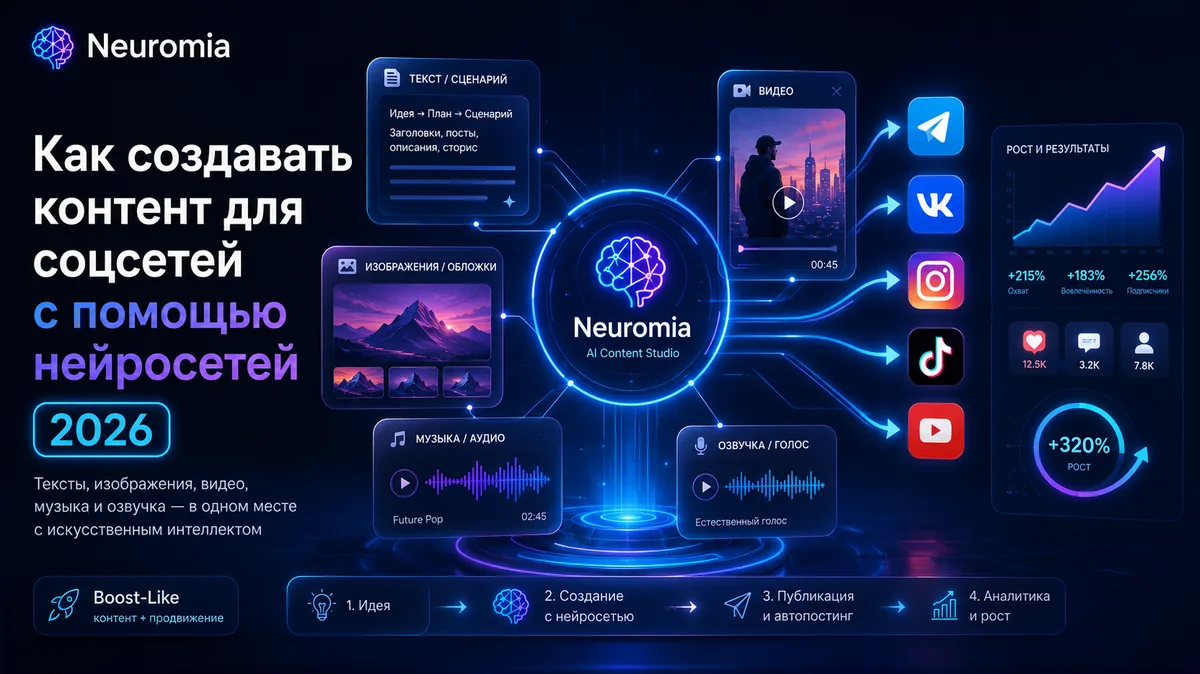
AI models for content creation solve exactly that problem. Today they cover almost the whole production cycle: from the idea and the script to a finished video with a voiceover and music. Let's look at what actually works and how to build AI into your content plan.
What AI can do for SMM in 2026
A couple of years ago AI could barely help beyond text. The picture is different now:
Text and scripts — posts, captions, section ideas, Reels scripts
Images — covers, product cards, illustrations in a consistent style
Video — short clips from text or a photo in a few minutes
Music — background tracks with no copyright headaches
Voiceover — realistic voices for video with no recorder or microphone
The main change of 2026 is the quality of video models. Clips generated by Veo, Kling or Seedance are already hard to tell from camera footage, and they reach the recommendations in numbers.
Text and scripts: the backbone of a content plan
Language models such as ChatGPT and Claude pay for themselves fastest on routine work:
A month's content plan for your niche and target audience
Scripts for short clips with a hook in the first 3 seconds
Adapting one post for different platforms — Telegram, VK, Instagram*
Titles and captions with keywords for search
A practical tip: do not ask the model to «write a post». Give it a role, a format and an example of a piece that worked. The difference in quality is several times over.
Images: covers and a consistent visual style
Image generators (Nano Banana, FLUX, Ideogram) cover everyday SMM tasks without a designer:
Covers for Reels and YouTube — how clickable a cover is directly affects views
Cards for carousels on VK and Telegram
Branded illustrations in a single style — the models can hold a reference
For social media it matters that you generate in the right aspect ratio from the outset: 9:16 for stories and Reels, 1:1 for the feed, 16:9 for YouTube.
Video: the format of 2026
Short vertical clips are the most heavily promoted format on every social network, and this is where AI saves the most time:
Text to video — describe the scene and get a finished clip (Veo, Kling, Seedance)
Bringing photos to life — a static image becomes a moving video, an excellent format for brands and personal pages
Video from an image — you generate a cover, then build a clip from it in the same style
A working combination for Reels and TikTok: a language model writes the script, an image model generates the base picture, a video model assembles the clip, and Suno adds the music. One person does in an evening what used to take a team a week.
Where to try AI models without a VPN or a foreign card
The main difficulty for Russian users is access: the leading models require a foreign card and a VPN, and subscribing to each service separately gets expensive.
A convenient answer is an aggregator that gathers the models into one account. For example, Neuromia is a Russian AI aggregator: ChatGPT, Claude, Nano Banana, Veo, Kling, Suno and other models are available from a single balance, with no VPN and payment by Russian card. For SMM work that is practical: text, images, video and music are generated in one place and you pay only for what you actually generate.
How to build AI into your content process
Ideas and planning — a language model generates topics for your niche a month ahead
Production — images and video from the finished scripts, batched a week at a time
Adaptation — one clip is spread across TikTok, Reels, Shorts and VK Clips with different captions
Publishing to a schedule — regularity beats a one-off viral hit
Analytics — once a week, look at which formats land and adjust the plan
Why generated content needs a starting boost
AI solves the production problem, but not the cold-start problem. Social algorithms judge a new clip by its first hours: if there are no views and no reactions, the content never reaches the recommendations — however good it is.
That is why experienced SMM specialists combine content generation with promotion:
New clips are given starting TikTok views so that the algorithm sees audience interest
The profile is strengthened with Instagram* followers — social proof affects how many new viewers convert into subscribers
Telegram channels get post views to keep an attractive view rate for advertisers
The «AI + promotion» combination is a production line: content is made quickly and cheaply, and the starting boost helps it break into the recommendations.
Conclusions
In 2026 AI is not a toy but a working SMM tool: text, covers, video and music are generated in minutes rather than days. Start small — with a content plan and scripts — then add images and video. And to make sure your generated content does not go unnoticed, give it a starting push — TikTok views, Instagram followers or Telegram views, depending on where you publish.
FAQ
Do social networks ban AI-generated content
No. TikTok, Instagram* and YouTube do not prohibit generated content — what matters is quality and audience response. Some platforms ask you to label AI content, but the label has almost no effect on reach.
Which AI models are best for short video
In 2026 the leaders are Veo, Kling and Hailuo: they produce realistic vertical clips from text or a photo. Suno is used for the music.
How much does it cost to create content with AI
Through aggregators that charge for actual generations (Neuromia, for example), a short clip costs tens to hundreds of roubles — several times cheaper than filming and editing.
Will AI help me reach the recommendations
AI takes care of content quality and consistency. Getting a clip into the recommendations is the algorithms' job — and they care about starting views, likes and retention. That is why content generation is combined with promotion.